

Decentralized Finance (DeFi) is revolutionizing how we think about money, banking, and financial services. Instead of relying on banks and financial institutions, DeFi uses blockchain technology to create an open, permissionless financial system accessible to anyone with an internet connection.
Understanding Traditional Finance vs. DeFi
In traditional finance (often called “TradFi”), banks and institutions act as intermediaries for every financial transaction. Want to send money overseas? You need a bank. Want a loan? You need a bank’s approval. Want to earn interest on savings? You’re at the mercy of whatever rate the bank offers.
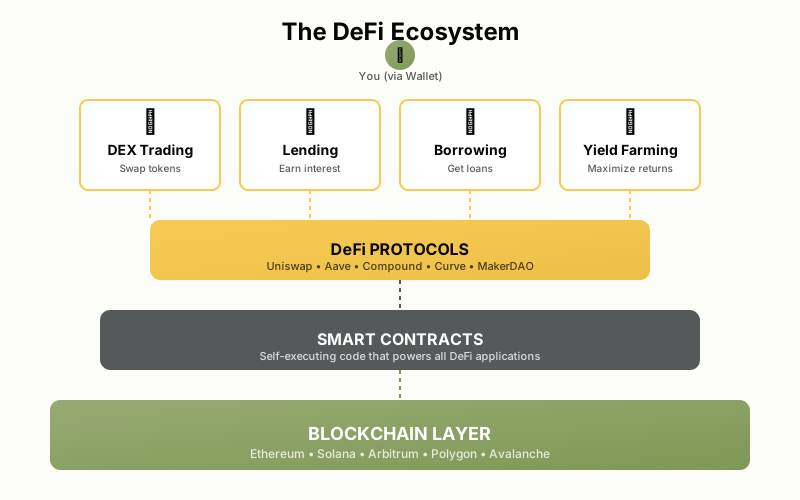
DeFi eliminates these middlemen through smart contracts—self-executing code that runs on a blockchain. These contracts automatically enforce the rules of financial agreements without human intervention.
Key Differences at a Glance
| Feature | Traditional Finance | DeFi |
|---|---|---|
| Access | Requires bank account, ID, credit check | Anyone with internet and a wallet |
| Operating Hours | Business hours, weekdays | 24/7/365 |
| Control | Bank controls your funds | You control your funds |
| Transparency | Opaque, private ledgers | Public, auditable blockchain |
| Speed | Days for international transfers | Minutes or seconds |
The Building Blocks of DeFi

1. Blockchain
The foundation of DeFi is blockchain technology—a distributed ledger that records all transactions across a network of computers. The most popular blockchain for DeFi is Ethereum, though others like Solana, Avalanche, and Arbitrum are gaining traction.
2. Smart Contracts
Smart contracts are programs stored on the blockchain that automatically execute when predetermined conditions are met. Think of them as digital vending machines: insert the right input, get the guaranteed output.
3. Cryptocurrencies & Tokens
- Cryptocurrencies (ETH, SOL) – Native blockchain currencies used for transaction fees
- Stablecoins (USDC, USDT, DAI) – Tokens pegged to $1 USD, essential for DeFi
- Governance Tokens (UNI, AAVE) – Give holders voting rights in protocols
- LP Tokens – Represent your share in a liquidity pool
What Can You Do with DeFi?
Swap Tokens (Decentralized Exchanges)
Trade one cryptocurrency for another without a centralized exchange. Platforms like Uniswap and PancakeSwap let you swap tokens instantly using liquidity pools instead of order books.
Lend & Borrow
Deposit your crypto to earn interest, or use your crypto as collateral to borrow other assets. Protocols like Aave and Compound facilitate this without credit checks.
Yield Farming
Maximize returns by strategically moving assets between protocols to earn the highest yields. This can include providing liquidity, staking, and leveraging incentive programs.
Provide Liquidity
Deposit token pairs into liquidity pools and earn a share of trading fees. This is how decentralized exchanges get the liquidity they need to facilitate trades.
The Risks of DeFi
Smart Contract Risk
Bugs in code can be exploited by hackers. Even audited protocols have been hacked for millions. Only use well-established protocols and never invest more than you can afford to lose.
Impermanent Loss
When providing liquidity, if token prices change significantly, you may end up with less value than if you had simply held the tokens.
Volatility
Cryptocurrency prices can swing 10-50% in a single day. Even stablecoins have occasionally lost their peg.
Key Takeaways
- DeFi is an open financial system built on blockchain, accessible to anyone
- Smart contracts replace banks and intermediaries
- You can trade, lend, borrow, and earn yield on your crypto
- Higher returns come with higher risks—start small and learn
- You control your funds, but you’re also responsible for security