
Uniswap didn’t just create a decentralized exchange—it sparked an entire financial revolution. From a simple idea in 2017 to processing over $1.5 trillion in cumulative volume, Uniswap’s journey is the story of DeFi itself. This comprehensive guide traces every milestone, innovation, and challenge that shaped the protocol.
The Genesis: From Mechanical Engineer to DeFi Pioneer
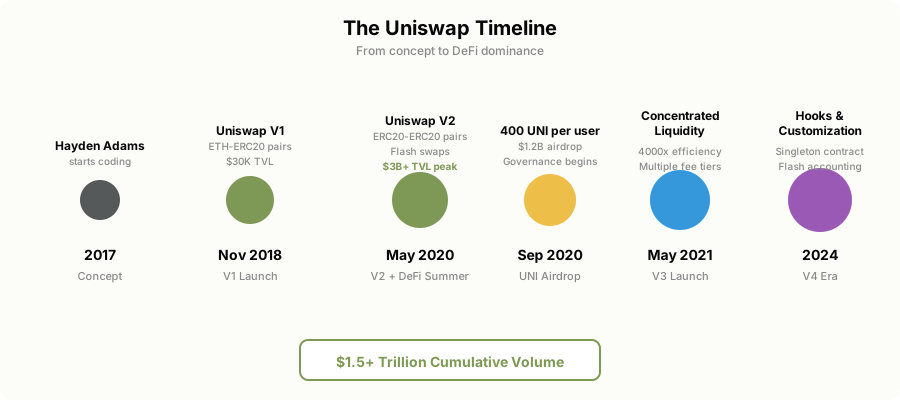
The Uniswap story begins in July 2017, when Hayden Adams was laid off from his job as a mechanical engineer at Siemens. What seemed like a setback became the catalyst for one of crypto’s most transformative innovations.
The Ethereum Revelation
Adams’ friend Karl Floersch, an Ethereum developer, suggested he learn about smart contracts. Floersch pointed him to Vitalik Buterin’s 2016 Reddit post describing the concept of an on-chain automated market maker. The idea was theoretical—no one had built it yet.
“I had no idea what I was doing. I just started coding and learning Solidity at the same time.”
— Hayden Adams, Uniswap creator
The Key Innovation: x * y = k
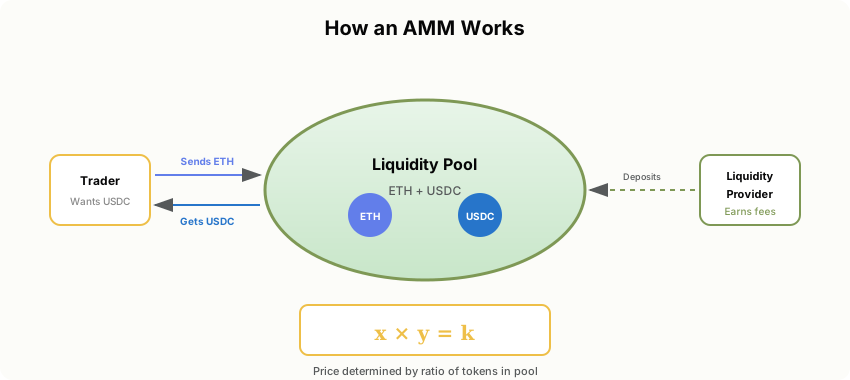
The breakthrough was elegantly simple. Instead of matching buyers and sellers like traditional exchanges, Uniswap uses a mathematical formula:
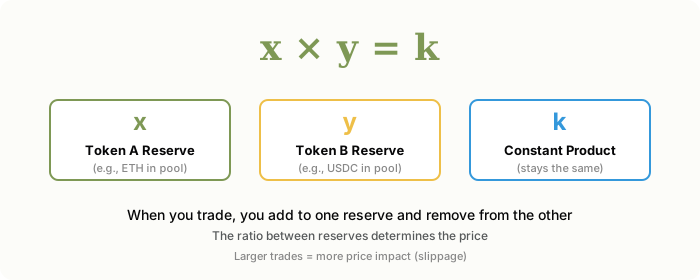
This formula means:
- No order books needed — The math handles price discovery
- Always available liquidity — You can trade any amount (with slippage)
- Permissionless — Anyone can create pools or provide liquidity
- Trustless — No intermediaries, just smart contracts
Uniswap V1: The Proof of Concept (November 2018)
After 18 months of development, Uniswap V1 launched on November 2, 2018, at Devcon 4 in Prague. The initial deployment was modest—funded by a $100,000 Ethereum Foundation grant.
V1 Characteristics
| Trading Pairs | ETH-ERC20 only (no direct token-to-token) |
| Fee Structure | 0.3% per trade, all to liquidity providers |
| Initial TVL | ~$30,000 |
| Smart Contract Size | ~300 lines of Vyper code |
Uniswap V2: The DeFi Summer Engine (May 2020)
V2 launched on May 18, 2020, introducing critical improvements that made Uniswap the backbone of DeFi Summer.
Key V2 Improvements
- ERC20-ERC20 Pairs — Direct token-to-token swaps without ETH intermediary
- Price Oracles — Time-weighted average prices for DeFi composability
- Flash Swaps — Borrow without collateral, repay in same transaction
The UNI Token: Decentralizing Governance
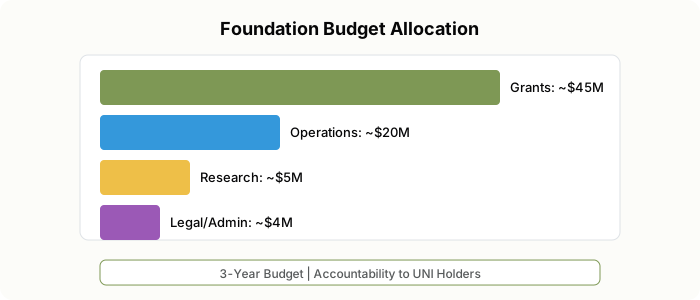
On September 16, 2020, Uniswap dropped one of crypto’s most generous airdrops. Every address that had ever used Uniswap received 400 UNI tokens—worth over $1,000 at launch and later peaking above $16,000.
Uniswap V3: The Efficiency Revolution (May 2021)
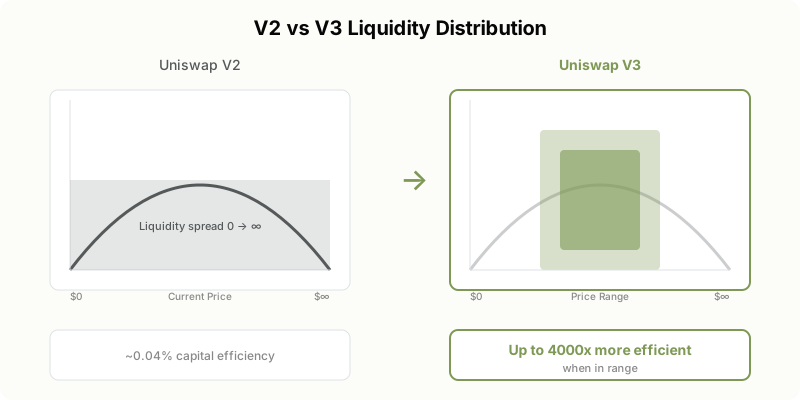
V3, launched May 5, 2021, represented the most significant AMM innovation since the original x*y=k formula. The headline feature: concentrated liquidity.
V3 Key Features
| Feature | Benefit | Trade-off |
|---|---|---|
| Concentrated Liquidity | Up to 4000x capital efficiency | Requires active management |
| Multiple Fee Tiers | 0.01%, 0.05%, 0.3%, 1% options | Liquidity fragmentation |
| NFT LP Positions | Unique, tradeable positions | More complex UX |
Uniswap V4: The Hooks Era (2024)
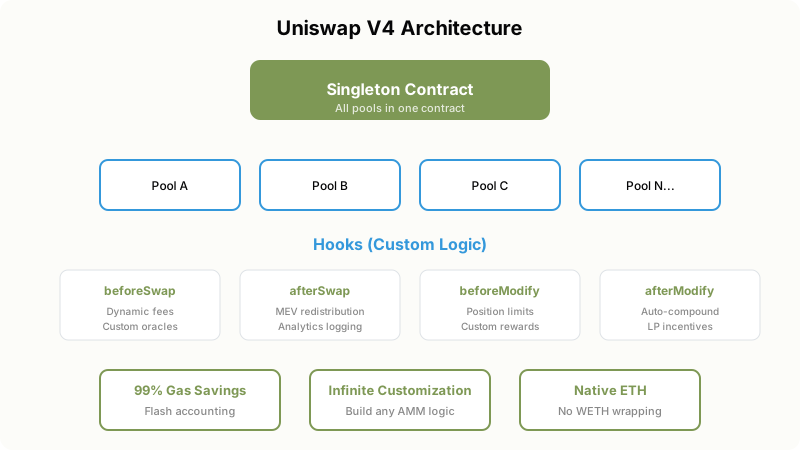
V4 represents the most ambitious upgrade yet, transforming Uniswap from a protocol into a platform.
What Hooks Enable
- Dynamic Fees — Adjust fees based on volatility, time, or other factors
- TWAMM — Execute large orders over time
- Limit Orders — Native on-chain limit orders
- MEV Mitigation — Return sandwich attack profits to LPs
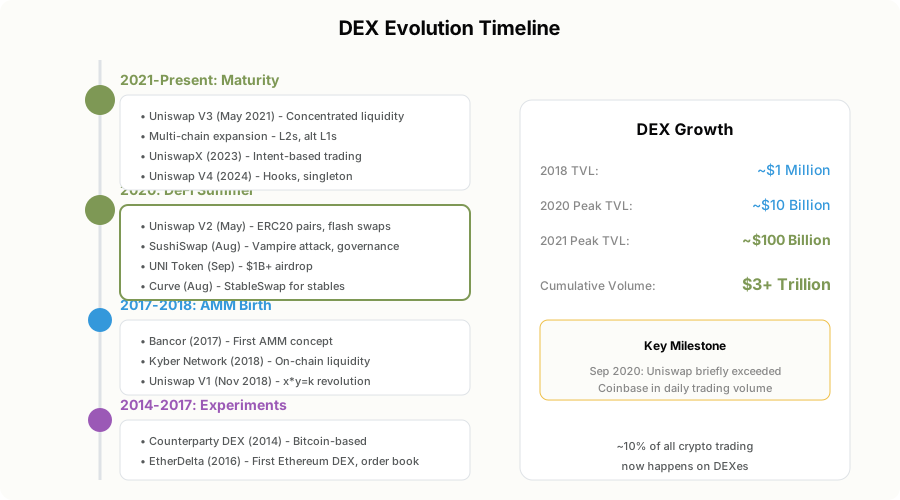
Uniswap’s Market Position Today
Key Lessons from Uniswap’s Journey
For Builders:
- Simplicity wins — x*y=k was elegant enough to work
- Ship early — V1 was imperfect but proved the concept
- Iterate based on data — Each version addressed real problems
- Community matters — The UNI airdrop built lasting loyalty
For Users:
- Understand each version — V2, V3, V4 have different trade-offs
- Participate in governance — UNI holders shape the protocol’s future
- Stay updated — DeFi moves fast; new features emerge constantly