

Uniswap governance puts protocol control in the hands of UNI token holders. From fee structures to chain deployments, treasury allocations to protocol upgrades—every major decision flows through community governance. This guide explains how to participate effectively.
Understanding UNI Token Voting Power
The UNI token is the governance token of the Uniswap protocol. Each UNI represents one vote in governance decisions.
Voting Power Mechanics
- 1 UNI = 1 Vote — Simple proportional voting
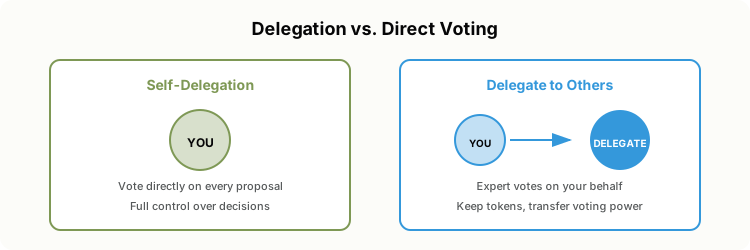
- Self-delegation required — You must delegate to yourself to vote directly
- Delegation is free — No gas cost to delegate (signing only)
- Votes are snapshotted — Balance at proposal creation determines voting power
The Governance Process: Step by Step
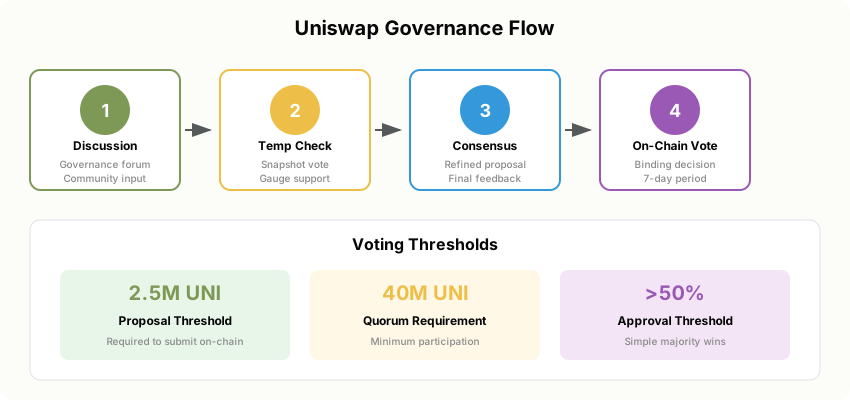
Phase 1: Forum Discussion
All proposals start as discussions on the Uniswap Governance Forum (gov.uniswap.org).
Phase 2: Temperature Check (Snapshot)
If forum discussion is positive, the proposal moves to a Temperature Check vote on Snapshot (off-chain, gas-free).
Phase 3: Consensus Check
A second off-chain vote with higher thresholds ensures broad support.
Phase 4: On-Chain Governance Vote
The binding vote occurs on-chain through the Governor contract with a 7-day voting period.
Delegation: Amplifying Your Voice
Not everyone can actively follow every proposal. Delegation allows UNI holders to entrust their voting power to active participants.
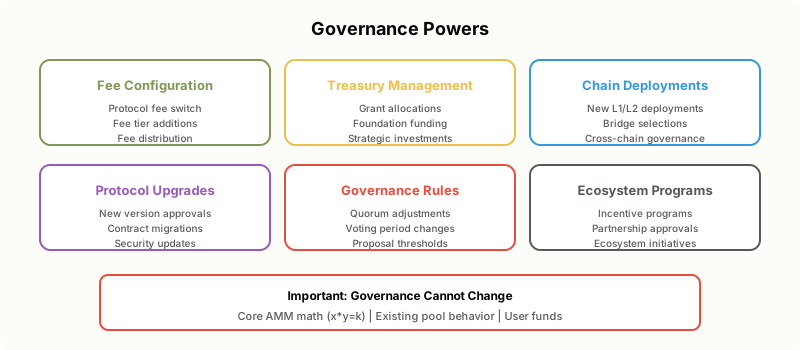
What Can Governance Decide?
The Fee Switch: The Big Decision
Perhaps the most significant pending governance decision is the protocol fee switch:
- Current state: 100% of fees go to LPs
- Potential: Protocol can take up to 1/6 of LP fees
- Governance decision: Whether, when, and how to activate
Key Takeaways
- UNI holders control protocol parameters, treasury, and upgrades
- Governance follows Discussion → Temperature Check → Consensus → On-chain Vote
- Delegation allows passive holders to have their votes cast by experts
- 40M UNI quorum and 2.5M proposal threshold prevent governance attacks
- The fee switch remains the most significant pending decision
- Anyone can participate — delegate, vote directly, or become a delegate